Sustainable Digital Leadership and University Teachers’ Sustainable Teaching Performance: The Mediating Role of Psychological Capital and Work Engagement
Authors
Files
Key Information
Journal
Published in Vol. 1 No. 4 (2026) of Sustainable Management Review.
Sustainable Management Review (SMR) is a multidisciplinary, peer-reviewed international journal dedicated to advancing research on sustainable management and sustainable development across disciplines. SMR welcomes sustainability-oriented studies from diverse academic fields, including but not limited to economics and management, public administration, culture, education, sociology, communication, law, environmental studies, biology, chemistry, materials science, engineering, water resources management, and other STEM-related areas. The journal encourages scholars to examine the application, transformation, and development of sustainability principles from organizational, social, technological, ecological, and institutional perspectives, thereby providing theoretical support and practical insights for more responsible, resilient, and future-oriented models of management and development.
ISSN3106-5805 eISSN3106-5813
About the JournalAbstract
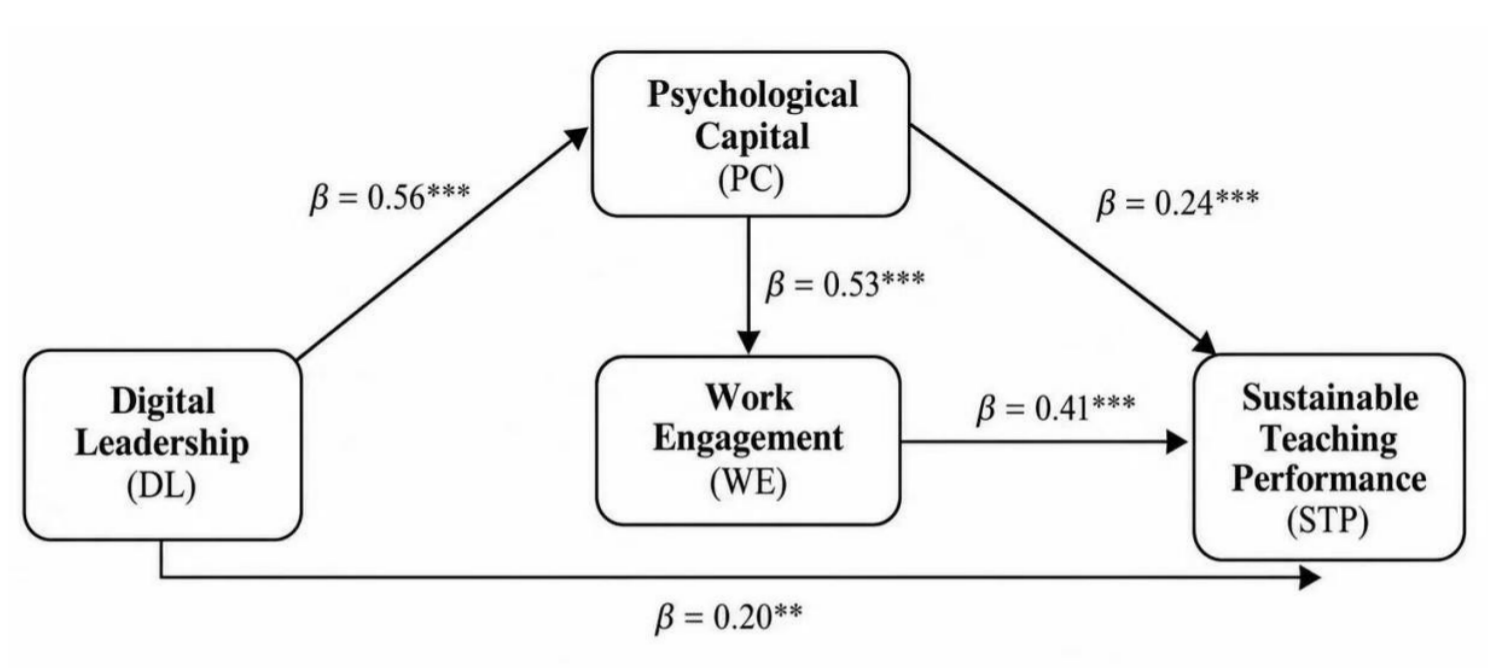
Digital transformation has reshaped higher education and increased the need for sustainable teaching performance. This study examines the relationship between digital leadership and university teachers’ sustainable teaching performance and explores the mediating roles of psychological capital and work engagement. Based on data from 376 university teachers in China, structural equation modeling with bootstrap analysis was conducted to test the proposed serial mediation model. The results showed that digital leadership significantly enhanced sustainable teaching performance. Moreover, digital leadership positively influenced psychological capital, which further promoted work engagement and improved teaching performance. Psychological capital and work engagement both served as significant mediators, while their serial mediation effect was also supported. These findings highlight the importance of integrating organizational leadership, teachers’ psychological resources, and professional engagement in promoting sustainable educational development. The study contributes to sustainable educational management by revealing the psychological and motivational mechanisms underlying the influence of digital leadership on teachers’ long-term teaching practices.
References
Avery, G. C., & Bergsteiner, H. (2011). Sustainable leadership practices for enhancing business resilience. Journal of Business Ethics, 98(3), 461–475. DOI: https://doi.org/10.1108/10878571111128766
Avolio, B. J., Sosik, J. J., Kahai, S. S., & Baker, B. (2014). E-leadership: Re-examining transformations in leadership source and transmission. The Leadership Quarterly, 25(1), 105–131. DOI: https://doi.org/10.1016/j.leaqua.2013.11.003
Borman, W. C., & Motowidlo, S. J. (1993). Expanding the criterion domain to include elements of contextual performance. In N. Schmitt & W. C. Borman (Eds.), Personnel selection in organizations (pp. 71–98). Jossey-Bass.
Budziszewska, M. D., Babiuch-Hall, M., & Wielebska, K. (2020). Love and Romantic Relationships in the Voices of Patients Who Experience Psychosis: An Interpretive Phenomenological Analysis. Frontiers in psychology, 11, 570928. https://doi.org/10.3389/fpsyg.2020.570928 DOI: https://doi.org/10.3389/fpsyg.2020.570928
Chaulagain, A., Pacione, L., Abdulmalik, J., Hughes, P., Oksana, K., Chumak, S., Mendoza, J., Avetisyan, K., Ghazaryan, G., Gasparyan, K., Chkonia, E., Servili, C., Chowdhury, N., Pinchuk, I., Belfar, M., Guerrero, A., Panteleeva, L., & Skokauskas, N. (2020). WHO Mental Health Gap Action Programme Intervention Guide (mhGAP-IG): the first pre-service training study. International journal of mental health systems, 14, 47. https://doi.org/10.1186/s13033-020-00379-2 DOI: https://doi.org/10.1186/s13033-020-00379-2
Hair, J. F., Black, W. C., Babin, B. J., & Anderson, R. E. (2019). Multivariate data analysis (8th ed.). Cengage.
Hobfoll, S. E. (2002). Social and psychological resources and adaptation. Review of General Psychology, 6(4), 307–324. DOI: https://doi.org/10.1037/1089-2680.6.4.307
Janssen, O. (2000). Job demands, perceptions of effort–reward fairness and innovative work behaviour. Journal of Occupational and Organizational Psychology, 73(3), 287–302. DOI: https://doi.org/10.1348/096317900167038
Kline, R. B. (2023). Principles and practice of structural equation modeling (5th ed.). Guilford Press.
Kopchak, O., Pinchuk, I., Ivnev, B., & Skokauskas, N. (2020). Reforming Undergraduate Psychiatry Training in Ukraine. Journal of medical education and curricular development, 7, 2382120520924000. https://doi.org/10.1177/2382120520924000 DOI: https://doi.org/10.1177/2382120520924000
Luthans, F., Youssef, C. M., & Avolio, B. J. (2007). Psychological capital: Developing the human competitive edge. Oxford University Press. DOI: https://doi.org/10.1093/acprof:oso/9780195187526.001.0001
Moreno, O., & Cardemil, E. (2018). The role of religious attendance on mental health among Mexican populations: A contribution toward the discussion of the immigrant health paradox. The American journal of orthopsychiatry, 88(1), 10–15. https://doi.org/10.1037/ort0000214 DOI: https://doi.org/10.1037/ort0000214
Mubarak, N., Safdar, S., Faiz, S., Khan, J., & Jaafar, M. (2021). Impact of public health education on undue fear of COVID-19 among nurses: The mediating role of psychological capital. International journal of mental health nursing, 30(2), 544–552. https://doi.org/10.1111/inm.12819 DOI: https://doi.org/10.1111/inm.12819
Schaufeli, W. B., Bakker, A. B., & Salanova, M. (2006). The measurement of work engagement with a short questionnaire. Educational and Psychological Measurement, 66(4), 701–716. DOI: https://doi.org/10.1177/0013164405282471
Sorkness, C. A., Pfund, C., Ofili, E. O., Okuyemi, K. S., Vishwanatha, J. K., NRMN team, Zavala, M. E., Pesavento, T., Fernandez, M., Tissera, A., Deveci, A., Javier, D., Short, A., Cooper, P., Jones, H., Manson, S., Buchwald, D., Eide, K., Gouldy, A., Kelly, E., … Womack, V. (2017). A new approach to mentoring for research careers: the National Research Mentoring Network. BMC proceedings, 11(Suppl 12), 22. https://doi.org/10.1186/s12919-017-0083-8 DOI: https://doi.org/10.1186/s12919-017-0083-8
Welch, S. B., Hansen, A., Nawagi, F., Singaram, V. S., Nelson, G. X., van Schalkwyk, S., Doobay-Persaud, A. A., Hall, Z. Z., & Kiguli-Malwadde, E. (2026). Functions, challenges and opportunities of health professions education units in Africa: a qualitative study across Eastern, Southern and Western regions. BMC medical education, 26(1), 41. https://doi.org/10.1186/s12909-025-08403-0 DOI: https://doi.org/10.1186/s12909-025-08403-0
World Medical Association. (2013). World Medical Association Declaration of Helsinki: Ethical principles for medical research involving human subjects. JAMA, 310(20), 2191–2194. DOI: https://doi.org/10.1001/jama.2013.281053
Details
License
Copyright (c) 2026 Xinrui Ju, Huixin Yuan, Bingbing Yao, Yixin Yang, Zhaoyu Zheng

This work is licensed under a Creative Commons Attribution 4.0 International License.