Sustainable Branding Strategy and Firm Performance: The Mediating Role of Customer Engagement and the Moderating Effect of Marketing Capability
Authors
Files
Key Information
Journal
Published in Vol. 1 No. 2 (2026) of Sustainable Management Review.
Sustainable Management Review (SMR) is a multidisciplinary, peer-reviewed international journal dedicated to advancing research on sustainable management and sustainable development across disciplines. SMR welcomes sustainability-oriented studies from diverse academic fields, including but not limited to economics and management, public administration, culture, education, sociology, communication, law, environmental studies, biology, chemistry, materials science, engineering, water resources management, and other STEM-related areas. The journal encourages scholars to examine the application, transformation, and development of sustainability principles from organizational, social, technological, ecological, and institutional perspectives, thereby providing theoretical support and practical insights for more responsible, resilient, and future-oriented models of management and development.
ISSN3106-5805 eISSN3106-5813
About the JournalAbstract
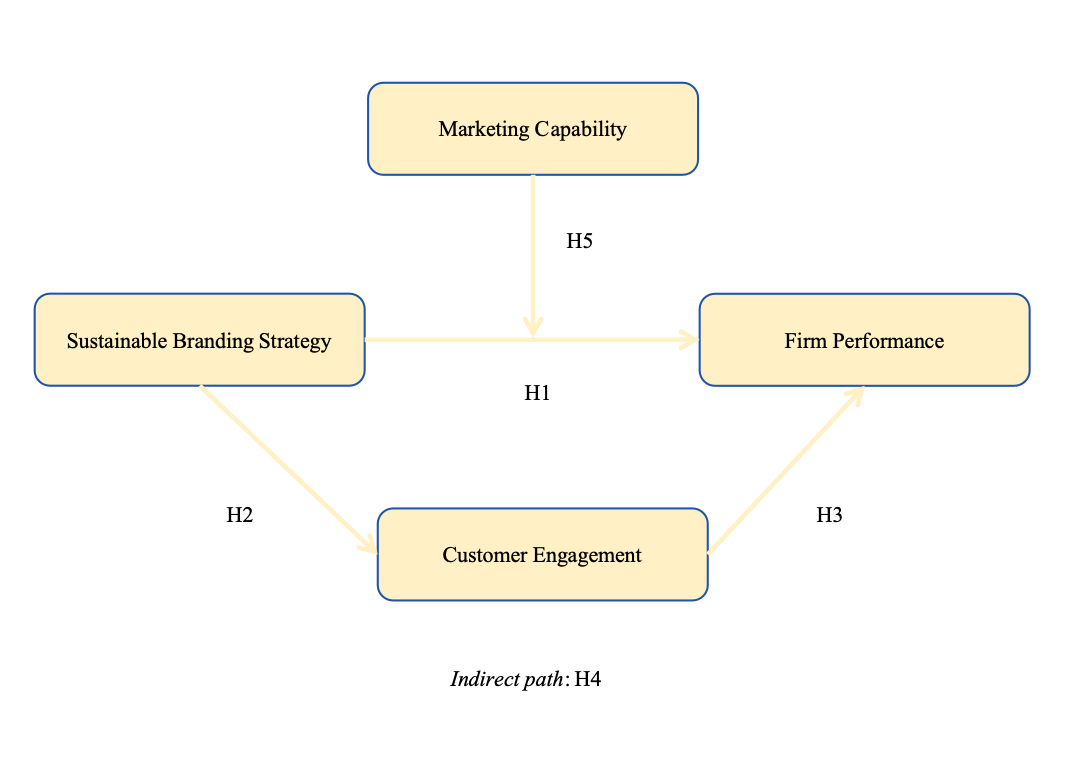
As sustainability increasingly shapes consumer preferences and corporate competition, firms are integrating environmental and social responsibility into branding strategies to enhance market performance. However, the mechanisms linking sustainable branding to firm performance remain insufficiently explored from a marketing perspective. Using panel data from publicly listed firms covering the period 2012–2023, this study employs fixed-effects regression models to examine the impact of sustainable branding strategy on firm performance, with customer engagement modeled as a mediating mechanism and marketing capability as a moderating factor. The findings indicate that sustainable branding strategy significantly improves firm performance. Customer engagement partially mediates this relationship, while marketing capability strengthens the effectiveness of branding strategies in generating performance gains. The results suggest that sustainability-oriented branding contributes to firm success when firms effectively engage customers and possess strong marketing capabilities, highlighting the strategic importance of integrating sustainability into marketing practices.
References
Bhattacharya, C. B. and Sen, S. (2004). Doing better at doing good: When, why, and how consumers respond to corporate social initiatives. California Management Review, 47(1):9–24. DOI: https://doi.org/10.2307/41166284
Bloom, N. and Reenen, J. V. (2007). Measuring and explaining management practices across firms and countries. Quarterly Journal of Economics, 122(4):1351–1408. DOI: https://doi.org/10.1162/qjec.2007.122.4.1351
Brodie, R. J., Hollebeek, L. D., Juric, B., and Ilic, A. (2011a). Customer engagement: Conceptual domain and implications for research. Journal of Service Research, 14(3):252–271.
Brodie, R. J., Hollebeek, L. D., Juric, B., and Ilic, A. (2011b). Customer engagement: Conceptual domain, fundamental propositions, and implications for research. Journal of Service Research, 14(3):252–271. DOI: https://doi.org/10.1177/1094670511411703
Chen, Y. S. (2010). The drivers of green brand equity: Green brand image, green satisfaction, and green trust. Journal of Business Ethics, 93(2):307–319. DOI: https://doi.org/10.1007/s10551-009-0223-9
Deari, H., Isejni, S., and Ferati, R. (2020). Green marketing and consumer behavior towards green brands. International Journal of Progressive Sciences and Technologies, 23:4–11.
Dembek, K., Singh, P., and Bhakoo, V. (2016). Literature review of shared value: a theoretical concept or a management buzzword? Journal of business ethics, 137(2):231–267. DOI: https://doi.org/10.1007/s10551-015-2554-z
Friede, G., Busch, T., and Bassen, A. (2015). ESG and financial performance: Aggregated evidence from more than 2000 empirical studies. Journal of Sustainable Finance & Investment, 5(4):210–233. DOI: https://doi.org/10.1080/20430795.2015.1118917
Harmeling, C. M., Moffett, J. W., Arnold, M. J., and Carlson, B. D. (2017). Toward a theory of customer engagement marketing. Journal of the Academy of Marketing Science, 45(3):312–335. Hart, S. L. (1995). A natural-resource-based view of the firm. DOI: https://doi.org/10.1007/s11747-016-0509-2
Academy of Management Review, 20(4):986–1014.
Hollebeek, L. D., Glynn, M. S., and Brodie, R. J. (2014). Consumer brand engagement in social media. Journal of Interactive Marketing, 28(2):149–165. DOI: https://doi.org/10.1016/j.intmar.2013.12.002
Kamboj, S. and Rahman, Z. (2015). Marketing capabilities and firm performance: literature review and future research agenda. International Journal of Productivity and Performance Management, 64(8):1041–1067. DOI: https://doi.org/10.1108/IJPPM-08-2014-0117
Kumar, V., Aksoy, L., Donkers, B., Venkatesan, R., Wiesel, T., and Tillmanns, S. (2010). Undervalued or overvalued customers: Capturing total customer engagement value. Journal of service research, 13(3):297–310. DOI: https://doi.org/10.1177/1094670510375602
Lins, K. V., Servaes, H., and Tamayo, A. (2017). Social capital, trust, and firm performance: The value of corporate social responsibility during the financial crisis. Journal of Finance, 72(4):1785–1824. DOI: https://doi.org/10.1111/jofi.12505
Loughran, T. and Mcdonald, B. (2016). Textual analysis in accounting and finance. Journal of Accounting Research, 54(4). DOI: https://doi.org/10.1111/1475-679X.12123
Vargo, S. L. and Lusch, R. F. (2008). Service-dominant logic: Continuing the evolution. Journal of the Academy of Marketing Science, 36(1):1–10. DOI: https://doi.org/10.1007/s11747-007-0069-6
Vorhies, D. W. and Morgan, N. A. (2005). Benchmarking marketing capabilities for sustainable competitive advantage. Journal of Marketing, 69(1):80–94. DOI: https://doi.org/10.1509/jmkg.69.1.80.55505
Details
License
Copyright (c) 2026 Dong Guo, Yixiao Xu, Wei Yet Tan

This work is licensed under a Creative Commons Attribution 4.0 International License.