Reconceptualizing University Libraries as Knowledge Ecosystems: Rethinking the Roles and Management of Academic Libraries
Authors
Files
Key Information
Journal
Published in Vol. 1 No. 2 (2026) of Sustainable Management Review.
Sustainable Management Review (SMR) is a multidisciplinary, peer-reviewed international journal dedicated to advancing research on sustainable management and sustainable development across disciplines. SMR welcomes sustainability-oriented studies from diverse academic fields, including but not limited to economics and management, public administration, culture, education, sociology, communication, law, environmental studies, biology, chemistry, materials science, engineering, water resources management, and other STEM-related areas. The journal encourages scholars to examine the application, transformation, and development of sustainability principles from organizational, social, technological, ecological, and institutional perspectives, thereby providing theoretical support and practical insights for more responsible, resilient, and future-oriented models of management and development.
ISSN3106-5805 eISSN3106-5813
About the JournalAbstract
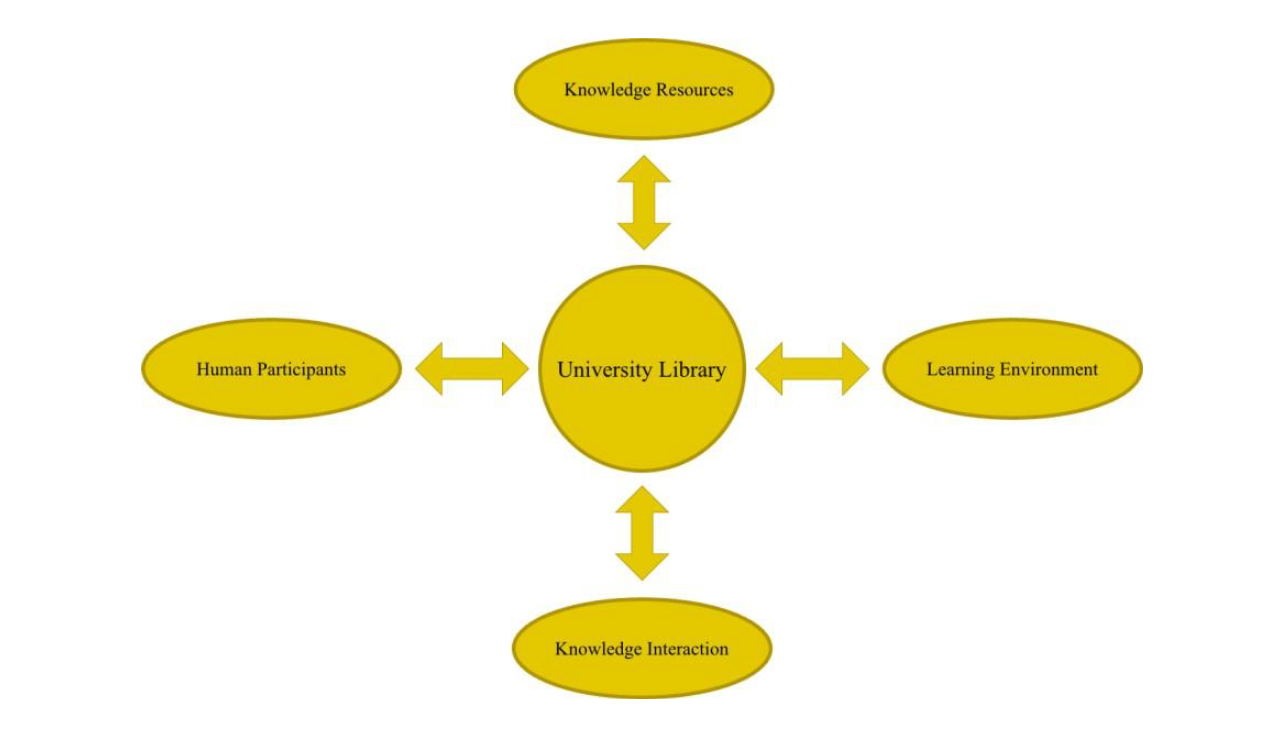
University libraries are undergoing profound transformation in response to digitalization, open science, and evolving academic practices. Traditional perspectives primarily conceptualize libraries as collection-centered repositories or information service institutions. While these views have shaped professional development, they insufficiently capture the dynamic and systemic nature of contemporary academic libraries. This study reconceptualizes the university library as a knowledge ecosystem. Drawing upon knowledge ecosystem theory, knowledge sharing theory, and learning environment perspectives, the paper proposes a four-component model consisting of knowledge resources, human participants, learning environments, and knowledge interaction. The model emphasizes interdependence, co-evolution, and collaborative knowledge creation within the academic context. Based on this framework, the study derives managerial implications that reposition libraries as knowledge hubs, librarians as facilitators, and libraries as academic communities. By integrating theoretical analysis with practical insights, this research provides a comprehensive framework for understanding and guiding the future development of university libraries.
References
Adner, R. (2006). Match your innovation strategy to your innovation ecosystem. Harvard Business Review, 84(4):98– 107.
Auckland, M. (2012).
Bennett, S. (2009). Borgman, C. L. (2007).
Bryson, J. M., Crosby, B. C., and Stone, M. M. (2006). The design and implementation of cross-sector collaborations. Public Administration Review, 66(s1):44–55. DOI: https://doi.org/10.1111/j.1540-6210.2006.00665.x
Clarysse, B., Wright, M., Bruneel, J., and Mahajan, A. (2014). Creating value in ecosystems: Crossing the chasm between knowledge and business ecosystems. Research Policy, 43(7):1164–1176. DOI: https://doi.org/10.1016/j.respol.2014.04.014
Corrall, S. (2010). Educating the academic librarian as a blended professional: A review and case study. Library Management, (8/9):567–584. DOI: https://doi.org/10.1108/01435121011093360
Foss, N. J., Husted, K., and Michailova, S. (2010). Governing knowledge sharing in organizations: Levels of analysis, governance mechanisms, and research directions. Journal of Management studies, 47(3):455–482. DOI: https://doi.org/10.1111/j.1467-6486.2009.00870.x
Järvi, K., Almpanopoulou, A., and Ritala, P. (2018). Organization of knowledge ecosystems: Prefigurative and partial forms. Research Policy, 47(8):1523–1537. DOI: https://doi.org/10.1016/j.respol.2018.05.007
Julien, H. and Genuis, S. K. (2011). Librarians’ experiences of the teaching role: A national survey of librarians. Library & Information Science Research, 33(2):103–111. DOI: https://doi.org/10.1016/j.lisr.2010.09.005
Lankes, R. D. (2011).
Nonaka, I. (1994). A dynamic theory of organizational knowledge creation. Organization Science, 5(1):14–37. DOI: https://doi.org/10.1287/orsc.5.1.14
Pinfield, S., Cox, A. M., and Smith, J. (2014). Research data management and libraries: Relationships, activities, drivers and influences. PLOS ONE, 9(12). DOI: https://doi.org/10.1371/journal.pone.0114734
Powell, W. W., Koput, K. W., and Smith-Doerr, L. (1996). Interorganizational collaboration and the locus of innovation. Administrative Science Quarterly, 41(1):116–145. DOI: https://doi.org/10.2307/2393988
Suber, P. (2012).
Tenopir, C., Birch, B., and Allard, S. (2012).
Wuchty, S., Jones, B. F., and Uzzi, B. (2007). The increasing dominance of teams in knowledge production. Science, (5827):1036–1039. DOI: https://doi.org/10.1126/science.1136099
Details
License
Copyright (c) 2026 Baohua Wang , Zhang Yi, Xiaoming Li , Wei Yet Tan

This work is licensed under a Creative Commons Attribution 4.0 International License.